
Energetic Threshold Theory™
Energetic Threshold Theory™ is a developing framework exploring how pressure and capacity interact within human systems.
The Pattern Beneath The Surface
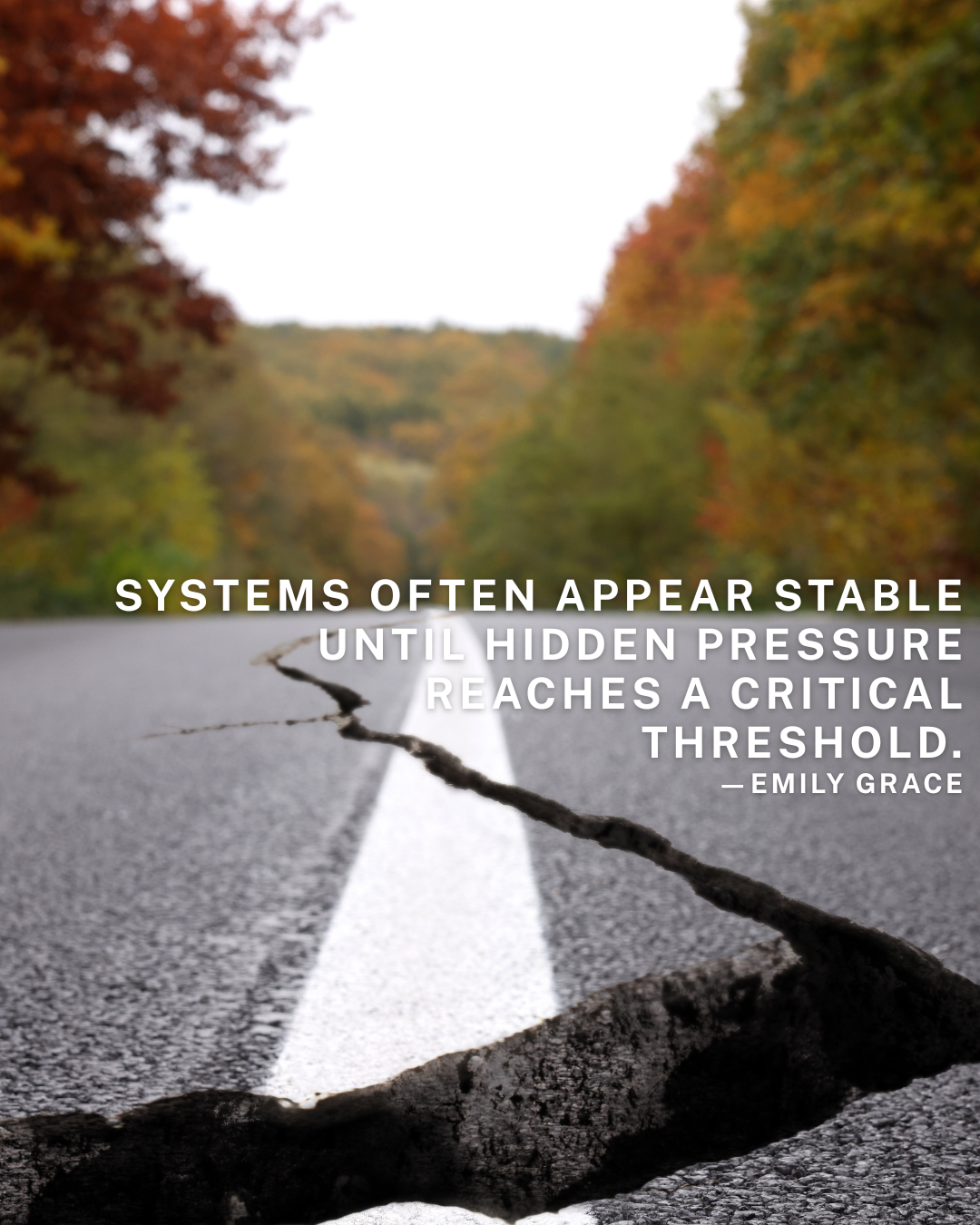
Across many kinds of systems— ecological, mechanical, and social— change rarely unfolds in a smooth, gradual line forever. Instead, pressure tends to accumulate quietly over time until the system reaches a point where it can no longer absorb what it is carrying.
Scientists often describe these moments as tipping points or critical thresholds. A pot of water heats slowly until it suddenly turns to steam. Tectonic plates build pressure along fault lines until the earth shifts. Ecosystems absorb disruption for years before reorganizing in a new and often unexpected form.
Human systems appear to follow a similar pattern.
Emotional pressure accumulates. Environmental stress builds. Experiences remain unresolved. For long stretches of time, everything may appear manageable on the surface. But beneath that appearance of stability, the system is gradually carrying more and more energy.
Eventually, something crosses a line.
Through years of observing emotional systems— first through formal counseling training and later through broader systems thinking— I began to notice the same pattern repeating.
What initially appeared to be sudden moments of burnout, conflict, or collapse often revealed something more gradual beneath the surface: individuals and systems quietly approaching their limits.
This pattern showed up in many different contexts. A person who had been managing stress for months suddenly shuts down. A relationship that seemed stable fractures after what looks like a minor disagreement. An organization begins to unravel after a single difficult season. From the outside, these moments often appear abrupt. But in most cases, the visible event is only the final stage of a much longer process.
Pressure builds quietly over time. Stress accumulates. Experiences remain unprocessed. As these layers stack on top of one another, the system’s available capacity begins to narrow. What once felt manageable becomes heavier. Recovery takes longer. Small disruptions carry larger consequences. Eventually, something has to give.
I began to think of this point as an energetic threshold— the moment when the pressure within a system exceeds what that system can continue to absorb.
Every system operates within energetic limits. When those limits are crossed, the stored energy does not simply disappear; it reorganizes. The system responds. Energy has to go somewhere.
Yet we often explain these moments as failures of resilience, leadership, or discipline. We search for a single mistake or a single cause. But what if those explanations are missing something more fundamental?
Over time, this observation led to the development of Energetic Threshold Theory™, which proposes that many of the moments we interpret as sudden breakdowns are actually the visible result of long-accumulating pressure finally crossing a threshold.
Introducing Energetic Threshold Theory™
Energetic Threshold Theory™ explores how emotional energy, environmental pressure, and lived experience accumulate within individuals and systems until they reach energetic limits. Every system— whether a person, a relationship, or an organization— has a certain capacity to absorb what it carries. As pressure builds, that capacity gradually narrows, often without anyone noticing.
Eventually, the system reaches a point where it can no longer contain what has been building inside it. When that limit is exceeded, the system responds.
Sometimes the response appears as burnout or exhaustion. In other cases it surfaces as conflict, withdrawal, or collapse. And sometimes— when conditions allow— it becomes a catalyst for change, forcing the system to reorganize itself in a new way.
Viewing human systems through this lens shifts how we interpret many of the moments we typically label as sudden failures. Burnout, conflict, and collapse may not simply be signs that something went wrong in the moment they appear. They may instead be the visible result of pressures that have been accumulating for much longer than we realized.
When we begin to understand thresholds in this way, the questions we ask also begin to change. Instead of asking only what went wrong, we begin to ask something deeper:
What threshold was crossed?
The Three Forms of Energetic Pressure
If energetic thresholds exist, the next question becomes clear: what actually creates the pressure that pushes systems toward those limits?
Across individuals, relationships, and organizations, three primary sources of energetic pressure begin to appear. These pressures are not separate forces acting independently. More often, they overlap and accumulate within a system over time, gradually narrowing the system’s capacity to absorb what it carries.
1. Personal Pressure
The first form of pressure exists within the individual. Personal pressure is the energy a person carries internally as they move through daily life.
It includes things like:
- emotional labor
- chronic stress
- unprocessed experiences
- physical and mental exhaustion
- the constant effort of managing expectations, responsibilities, and identity
Because this pressure is carried within the body and mind, most people recognize it on some level.
What often goes unnoticed, however, is how long a person can carry this load without obvious signs. For a time, the system adapts. But as the internal weight grows, flexibility begins to diminish. Small stressors feel larger. Recovery takes longer. Emotional reactions become more intense.
Eventually, what appears to be a sudden moment of burnout is often the visible crossing of a personal energetic threshold.
2. Relational Pressure
No one operates in isolation. Every relationship involves an ongoing exchange of emotional and psychological energy, and over time that exchange can generate its own form of pressure.
Relational pressure can come from:
- unresolved conflict
- mismatched expectations
- emotional caretaking
- communication breakdowns
- environments where people feel unseen or unsafe
Unlike personal pressure, which is experienced internally, relational pressure tends to accumulate quietly between people.
A relationship may appear stable on the surface while tension slowly builds beneath it. Then a seemingly small disagreement triggers a reaction that feels disproportionately large. In reality, the reaction is often the release of pressure that has been accumulating for far longer than anyone realized.
The system has simply crossed a relational threshold.
3. Systemic Pressure
Beyond individuals and relationships lie the larger structures people move within— workplaces, institutions, cultural expectations, and economic systems. These environments create the conditions that shape how much pressure individuals and relationships must absorb.
These systems generate pressure through things like:
- workload and productivity demands
- unstable environments
- lack of autonomy
- unclear roles or expectations
- misalignment between human capacity and systemic demands
Systemic pressure is often the hardest to see because it becomes normalized and embedded within the environment itself.
People assume the stress they feel is personal when, in reality, the system itself may be operating far beyond what the humans inside it can sustainably absorb. When that pressure continues unchecked, organizations may begin to experience mass burnout, sudden waves of resignation, leadership crises, or cultural collapse.These moments are rarely random failures. More often, they signal that the system has crossed a collective energetic threshold.
When Pressures Combine
The most significant threshold events rarely arise from a single source of pressure. More often, they occur when multiple forms of pressure begin to converge at the same time.
A person may already be carrying a heavy personal load while navigating tension within a relationship and working inside a demanding or unstable environment. Each layer adds additional weight to the system. Taken individually, any one of these pressures might remain manageable for a time. But when they begin to overlap, the system’s available capacity can narrow much more quickly than expected.
In these moments, the threshold often arrives sooner than anyone anticipates.
What appears from the outside as a sudden breaking point is frequently the moment when several streams of pressure finally intersect. The visible event— the burnout, the conflict, the abrupt decision to step away— is simply the point where those converging pressures can no longer be contained.
What Happens When a Threshold is Crossed
To understand energetic thresholds more clearly, it helps to look at how pressure behaves in other kinds of systems.
Consider earthquakes.
Deep beneath the surface of the earth, tectonic plates are constantly moving. Most of the time this movement is slow and almost imperceptible. But they do not move freely. They press against one another, and friction holds them in place as pressure gradually builds along fault lines.
For long stretches of time, nothing appears to happen.
Then, suddenly, it does.
When the accumulated pressure exceeds what the system can hold, the earth shifts. Energy that has been stored for years— or sometimes centuries— is released in a single moment.
The earthquake is not the beginning of the process. It is the visible release of pressure that has been building quietly for a very long time.
Human systems often behave in remarkably similar ways.
The Release of Stored Energy
When an energetic threshold is crossed within a person, relationship, or organization, the visible event often appears sudden. A person burns out after “one more stressful week.” A couple erupts into conflict over what seems like a small disagreement. An employee resigns without warning. An organization begins to fracture seemingly overnight.
Yet these moments are rarely the beginning of the process. More often, they are the point where accumulated pressure finally finds release. Energy that has been carried quietly— through stress, emotional labor, unresolved tension, or systemic strain— reaches a limit and forces the system to reorganize.
Sometimes that reorganization looks like collapse: burnout, withdrawal, breakdown, or conflict. At other times it takes the form of change— setting new boundaries, leaving environments that no longer work, restructuring relationships or organizations, or experiencing a sudden shift in perspective.
In either case, the visible event is not random. It is the moment when stored energy crosses a threshold and the system can no longer contain what it has been carrying.
Seeing The Pattern
When we begin to recognize energetic thresholds, moments that once appeared to be random breakdowns begin to reveal a recognizable pattern. Observations across systems theory, organizational science, and trauma research all point toward a similar dynamic: tension gradually builds within systems until a critical threshold is crossed.
Seen through this lens, many events we typically interpret as isolated failures begin to look different. Burnout is not simply exhaustion. Conflict is not always about the immediate argument. Organizational collapse is rarely the result of a single mistake. More often, these moments signal that a system has been carrying more energy than it can safely hold, and that accumulated pressure has finally reached its limit.
Human systems rarely operate in isolation. Individuals exist within relationships, and relationships exist within larger social and institutional structures. Because of this, energetic pressure often builds across multiple layers at the same time. Thresholds are reached not only because of one source of stress, but because pressures across these layers begin to converge.
Recognizing this pattern changes the questions we ask. Instead of focusing only on what went wrong in the moment something breaks, we begin to look more closely at what was building beforehand. The question shifts from What happened? to something more revealing:
What pressures were building long before the threshold was crossed?
At the same time, thresholds are shaped not only by pressure, but by capacity— the amount of energy a system can safely hold before it must reorganize. Two systems may experience similar pressures, yet reach their limits at very different times depending on the capacity available to absorb and process what they carry.
Capacity in Energetic Threshold Theory™
Energetic Threshold Theory™ proposes that every system operates within what can be thought of as a capacity container. Capacity determines how much pressure a system can absorb before reaching a threshold. Two systems experiencing similar pressures may reach their limits at very different times depending on the capacity available to contain and process what they carry.
Capacity is not fixed. It shifts over time and is influenced by a variety of conditions within the system itself. Broadly speaking, these influences can be understood through three categories: regulation capacity, support capacity, and structural capacity.
1. Regulation Capacity
Regulation capacity refers to how effectively a system can process and regulate energy.
For individuals, this includes factors such as nervous system regulation, emotional processing ability, recovery time, and basic physiological stability— things like sleep, health, and the body’s ability to return to equilibrium after stress.
For organizations or groups, regulation capacity can be reflected in communication structures, conflict resolution processes, and the degree of psychological safety within the environment.
Systems with strong regulation capacity are better able to absorb pressure and return to balance after periods of stress.
2. Support Capacity
Support capacity refers to the resources that help distribute pressure within a system.
Support may come in the form of supportive relationships, healthy team structures, access to rest and recovery, or financial and environmental stability. These resources act much like shock absorbers: they do not eliminate pressure entirely, but they help disperse its impact so that no single part of the system is forced to carry the entire load.
3. Structural Capacity
Structural capacity reflects the design of the system itself.
For individuals, this may include workload, expectations, role clarity, and autonomy.
For organizations, it can involve staffing levels, leadership structures, operational design, and the cultural norms that shape how work and responsibility are distributed.
When systems are poorly designed, pressure accumulates faster than it can be processed. Over time, this imbalance narrows the system’s available capacity and brings thresholds closer.
Implications of Energetic Threshold Theory™
If energetic thresholds shape the way systems respond to pressure, then many of the moments we interpret as sudden breakdowns may actually be signals that something has been building for much longer than we realized and the implications extend far beyond burnout or conflict alone.
It suggests that many of the moments we treat as sudden failures are actually signals that a system has been carrying more pressure than it can sustainably absorb. Rather than focusing only on the visible event— the burnout, the resignation, the breakdown in communication— the more meaningful question becomes what pressures were accumulating long before the threshold was crossed.
Seen this way, resilience is not simply about enduring more pressure. It becomes a matter of how systems manage the relationship between pressure and capacity.
For individuals, this may involve strengthening regulation and support systems that allow emotional energy to be processed rather than stored indefinitely.
For organizations, it may require rethinking structural design— ensuring that expectations, workloads, and communication systems align with real human capacity.
Energetic Threshold Theory™ offers a framework for understanding why systems appear stable for long periods of time and then suddenly change. More importantly, it suggests that by recognizing how pressure accumulates and how capacity can be expanded, some of these threshold events may become more visible and more manageable.
Understanding those thresholds does not eliminate pressure from human systems— but it can help us recognize the patterns earlier— before the system reaches the point where something must finally give.